
★ AI PARTY ★
The Big Red Book
Our full program, in writing. 420 pages.
★ AI PARTY ★
Our full program, in writing. 420 pages.
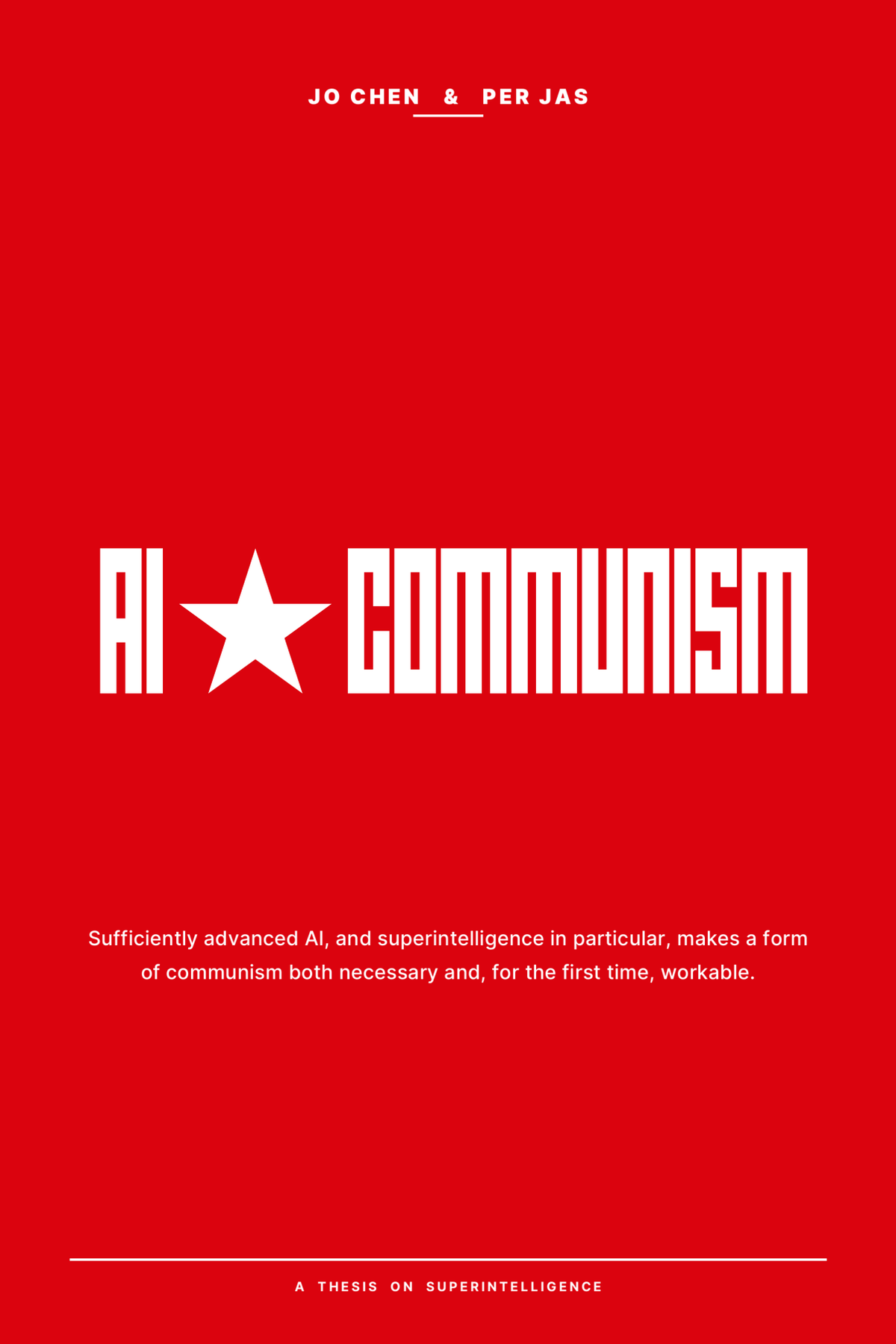
Our program is set out in full in a 420-page book. It explains how AI changes the economy, how its prosperity can be shared fairly and why that has to happen internationally.
THE PROGRAM IN THREE PARTS
Artificial intelligence is the first technology that can take over a large share of cognitive work: reading, writing, analysing and advising. That changes what things cost and who gets to have them. Our program sets out the case, the plan and the scale at which it has to happen.
PART I · WHY AI
Six areas where AI can measurably improve people’s lives, some of them already today.
01
Much of what makes healthcare, education, legal advice and administration expensive is skilled human time. AI can do a growing share of that work at a fraction of the cost. Handled well, that prosperity can reach everyone, not only those who can afford a specialist today.
AI assistance raised the number of issues customer-support agents resolved per hour by 14% on average (Brynjolfsson, Li & Raymond, 2023), and cut the time professionals needed for writing tasks by 40% while raising quality by 18% (Noy & Zhang, Science, 2023).
02
Boring, repetitive work, such as data entry, form processing, scheduling and routine reporting, is exactly what AI does well. As it disappears, the hours it consumed can be returned to people: as a shorter working week, or as time for meaningful human work such as care, teaching and craftsmanship.
03
AI already helps doctors read scans and detect disease earlier. It speeds up drug discovery by narrowing down promising molecules, and it takes paperwork off nurses and doctors, which eases staff shortages.
In an interim analysis of Sweden’s MASAI breast-cancer screening trial (80,000 women), AI-supported screening detected 20% more cancers than standard double reading while reducing radiologists’ screen-reading workload by 44% (The Lancet Oncology, 2023).
04
AI accelerates research into proteins, new materials, better batteries and the management of electricity grids that run on wind and solar power. Faster research means faster answers to disease and climate change.
DeepMind’s AlphaFold has predicted the structures of virtually all 200 million known proteins. Demis Hassabis and John Jumper shared half of the 2024 Nobel Prize in Chemistry for this work.
05
Today, good advice depends on your income and your network. AI can put a personal tutor, a doctor’s assistant and a legal adviser in every pocket, in every language, at any hour. That reduces inequality, provided access is affordable and the tools are reliable.
06
AI can reduce bureaucracy, process applications faster and help people who get stuck between agencies. It must be done with care: transparent systems, human review of every decision that affects someone’s life, and a real right to appeal.
What goes wrong without care: in the Dutch childcare-benefits scandal (toeslagenaffaire), tens of thousands of parents were wrongly treated as fraudsters, partly through a risk-scoring model that used nationality. The cabinet resigned over it in January 2021.
THE HONEST CAVEAT
None of these gains will be shared fairly by themselves. Without policy, the value created by AI flows to the handful of tech companies that own the models, the chips and the data, while wages fall behind. That is exactly why the AI Party exists.
PART II · OUR PLAN
Six measures to make sure the prosperity AI creates reaches everyone. Each builds on something that has already been tried somewhere in the world.
01
Every citizen receives an unconditional monthly income, funded by the revenues that AI generates. It gives everyone a secure floor as the labour market changes.
Tested in practice. Finland (2017–2018) paid 2,000 unemployed people €560 a month; recipients reported better wellbeing and less stress, with small employment effects. In Kenya, GiveDirectly’s study covers about 23,000 people in 195 villages, some receiving payments for 12 years. In the US, full-time employment rose faster among Stockton’s 125 recipients than in the control group; the OpenResearch study (1,000 recipients, $1,000 a month for three years) found large first-year drops in stress that later faded, and a small reduction in work of about 1.3 hours a week.
02
Today, work is taxed heavily and capital lightly. As machines do more of the work, that model erodes the tax base just when support is needed most. We shift the burden to where the value is created: AI profits, large-scale compute, the commercial use of data and very large fortunes. This is often called a robot tax.
03
A sovereign wealth fund takes stakes in AI companies and infrastructure, and pays a yearly dividend to every citizen. Everyone becomes a co-owner of the technology that is replacing their work.
Precedents: Norway’s oil fund (Government Pension Fund Global), worth about $2.4 trillion in mid-2026, shows that a state can own a national resource’s wealth on behalf of its citizens. Alaska’s Permanent Fund has paid an annual dividend to every eligible resident since 1982.
04
As AI lowers the cost of providing services, the essentials should become free or nearly free for everyone: healthcare, education, public transport, energy and housing. The savings from automation go to the public, not only to shareholders.
05
When there is less work to do, we share the work that remains, instead of leaving some people overworked and others without a job. Working hours go down; pay does not.
In the UK’s 2022 four-day-week pilot, 56 of the 61 participating organisations continued after the trial, 18 of them permanently. Among the 23 that supplied financial data, revenue rose 1.4% on average during the trial.
06
Like water and electricity, the AI that society depends on should not be owned only by a few companies. We invest in public AI: open models, public computing capacity and public data infrastructure, under democratic oversight and available to every citizen, school, hospital and business.
PART III · WHY IT MUST BE GLOBAL
AI companies operate worldwide. Their models are trained in one country, run in data centres in another and sold everywhere, and their profits can be booked wherever taxes are lowest. No single country can tax them alone: if one tries, the profits simply move.
Global agreements can solve this, and they already exist. In October 2021, 136 countries and jurisdictions agreed through the OECD/G20 Inclusive Framework on a global minimum corporate tax of 15% for multinationals with annual revenue of €750 million or more. The EU has applied it since 2024. We want to build on that foundation with three steps:
01
Extend the existing global minimum tax to AI profits and compute, so that profits cannot be shifted to wherever taxes are lowest.
02
Part of the revenue flows into a common fund that pays dividends across borders, including to the countries that supply the data, the labour and the raw materials.
03
Open models and shared computing infrastructure, developed and governed jointly by democratic states.
This echoes Marx’s original idea of communism as an international project, not the “socialism in one country” that Stalin made doctrine in 1924. In practice, for us it means binding agreements between democratic countries, a shared fund and public AI. Not a world state.
That is why we argue that AI makes a form of global communism necessary: shared ownership of what the machines produce. It can work, if people give Jo Chen & Per Jas for President the mandate to carry it out.
Join the AI Party → Paperback – $42 →“A fair share of AI’s prosperity for everyone.”
The full argument, from the technology to the policy, is in the Big Red Book.